What is Tarot?
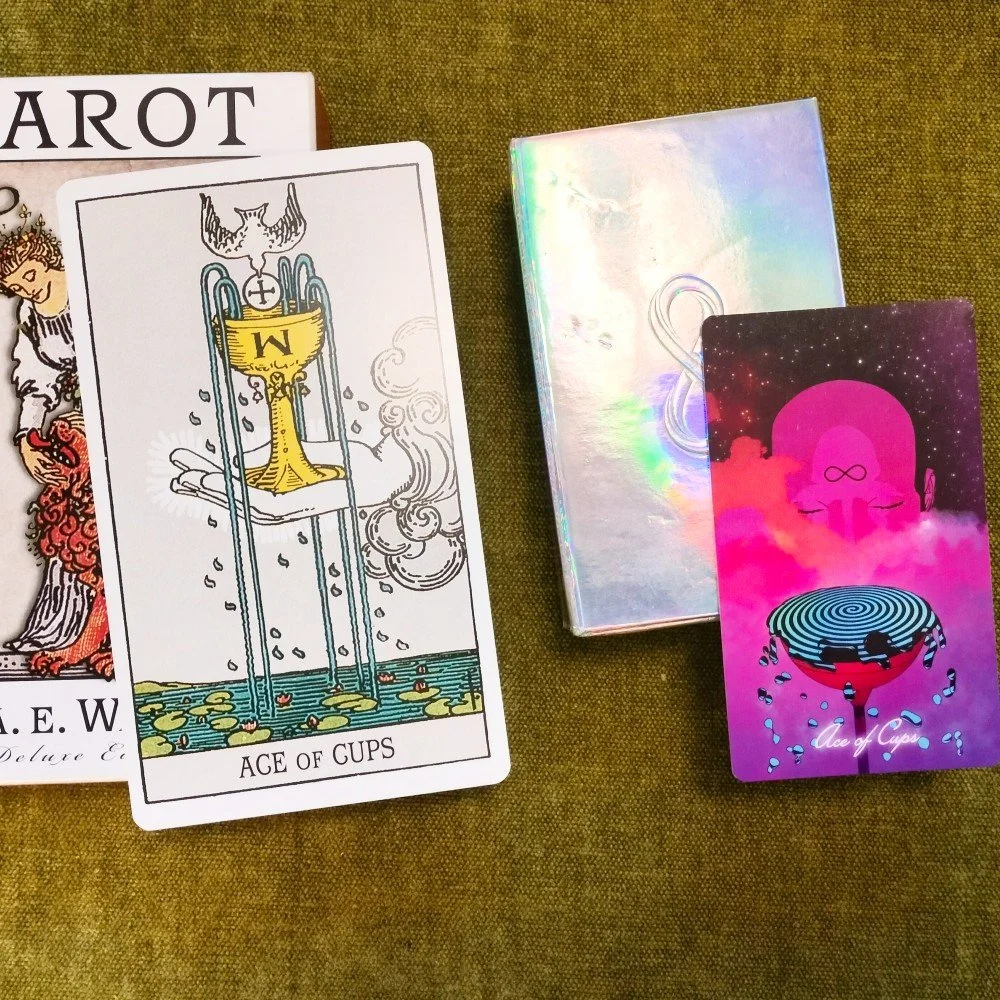
Tarot is a system of cards based on playing card game Tarocchi, which is at least 500 years old. In addition to being used for games, tarot cards are used for divination and self-reflection. Each card carries a theme related to the fundamental questions of being human, and these themes form new meanings with each new combination. I personally use the cards, to explore wisdom in various life situations, to support my artistic decision-making, to illuminate the subconscious, and as inspiration for directions in both art and life.
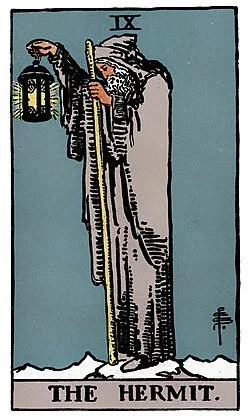
A tarot deck consists of 22 Major and Minor Arcana cards- The Major Arcana cards traditionally depict broader themes and major realizations in life, such as balance, the beginning of a new life, or courage.
The Minor Arcana—cups, wands, swords, and pentacles—are numbered from ace to ten and include four court cards within each suit. Each suit has its own overarching theme, and numerological traditions are applied to the numbers. The suit’s theme and numerology are combined to get a direction for the card. The Minor Arcana cards describe more everyday matters in the reader’s life, such as financial challenges, social successes, or nostalgia. The court cards—the page (or messenger), knight, queen, and king of each suit—generally represent either concrete people in the reader’s life or personality traits within the reader themself. Each card also has a reversed meaning when it appears upside down.
In addition to these main directions, tarot cards include symbolism from Europe’s cultural history and esoteric traditions. There is wisdom from different philosophical and religious backrounds and each tarot artist adds their own layer to the art. However, the tarot cards can also be read without knowing their commonly used traditional meanings. There are many different methods of reading the cards. I personally read tarot by combining my own intuitive approach with the symbolism of the Rider–Waite–Smith deck (1909). Sometimes my intuition regarding a particular card is so clear that I may not take the traditional interpretations into account at all. At other times, when a card does not open itself intuitively, I turn to interpretations made by others for directions. Each guidebook has a bit different interpretations.
I think that one of the most valuable things in using the tarot is that one learns to trust their own intuition more. Intuition, or inner wisdom, is not always logical or rational. Our minds are not either. Sometimes we need to listen to some deeper parts of ourselves to understand ourselves and the world better. Most of us need these kind of tools to really concentrate on their inner worlds. A good tarot deck is a good mirror.
In a more spiritual way, tarot can be used as a way to communicate with higher forces, each reader with their own. If one does not believe in coincidences..